

Wouldn’t it be cool to say you observe primates for a living? Yes, primates, as in monkeys — langurs to be exact.
Meet Brenda de Groot, a PhD in Primatology and Wildlife Science candidate. She’s made it her mission to study and protect these primates, and in doing so, she’s crafting a career that’s anything but ordinary.
“I remember hearing one of the earliest Japanese primatologists say, ‘Just go into the forest and watch the langurs,’” Brenda recalls, laughing. “They wanted me to form my own opinions by simply observing. That’s the beauty of primatology — it starts with curiosity.”
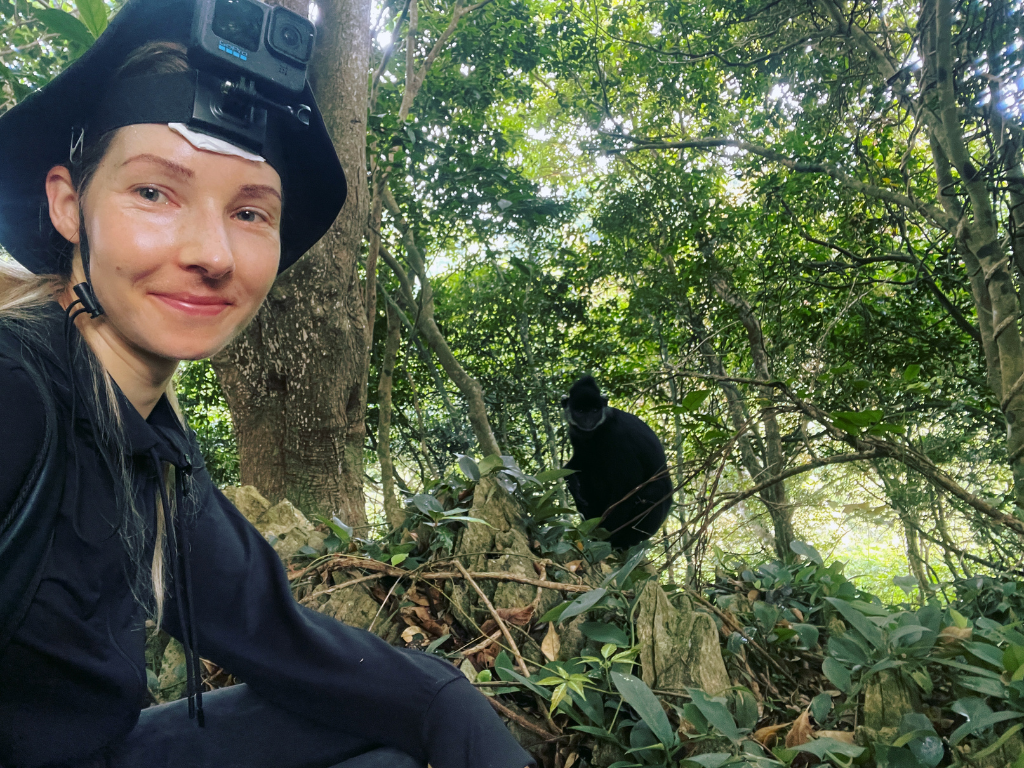
Brenda with a langur monkey during her fieldwork in Vietnam. Source: Brenda de Groot
Studying the underdogs of primatology
In many parts of the world, primates are misunderstood. They’re seen as pests, pets, or even props for entertainment. But in primatology, these animals are valued for their social complexity, intelligence, and emotional depth.
To her, langurs are precious.
So much so that she’s built her entire academic journey around studying and protecting them — one degree at a time.
“I’m still at the beginning of my PhD,” she says. “But what I know for sure is that I’m focused on Trachypithecus langurs. I want to understand their cognition and behaviour, how they think, how they communicate, how they live.”
While most people are familiar with chimpanzees, baboons, orangutans, and gorillas — the classic stars of both science and cinema — langurs are largely overlooked in primatology research.
“There’s just not much known about them,” Brenda explains. “My supervisor published a book about colobines (leaf-eating monkeys) and wanted to include a chapter on their cognition. But there isn’t enough data to write one. That’s how little we know.”
And that’s a huge problem, because langurs are in danger.
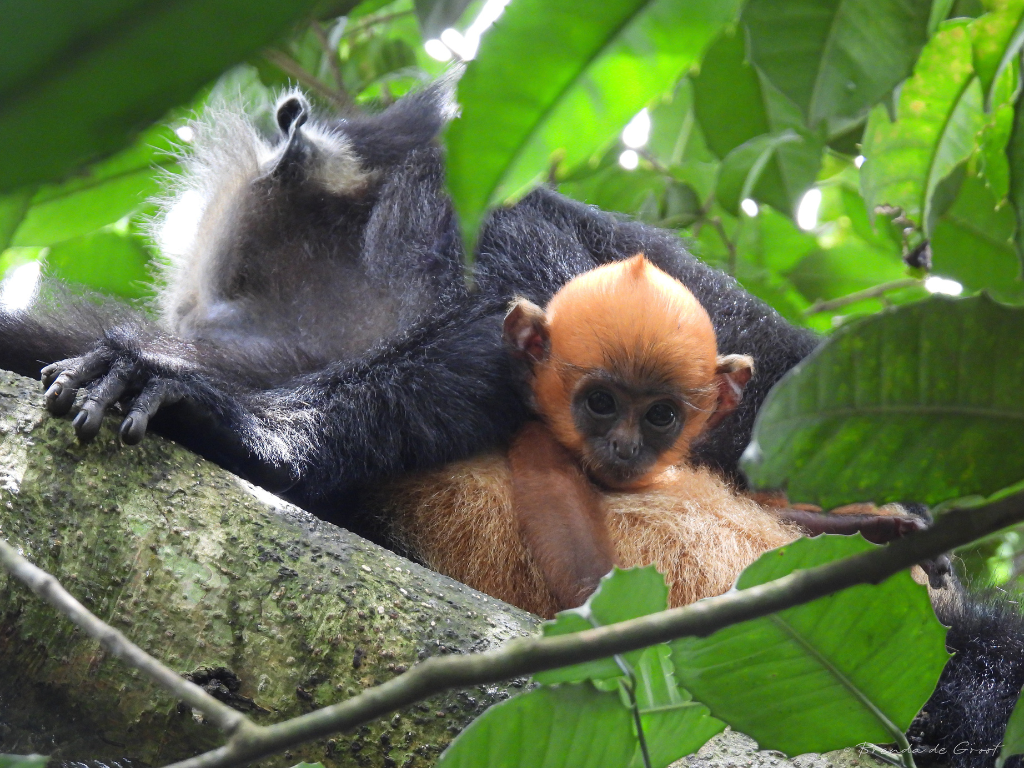
An adult and baby langur that Brenda stumbled upon during her fieldwork. Fun fact: The name “Langur” comes from a Hindu term meaning “long-tailed”. Source: Brenda de Groot
A conservation crisis on Langurs
Langurs are critically endangered, with their numbers rapidly declining due to habitat destruction, poaching, and disease, much of which is driven by human activity.
That’s why Brenda’s work in primatology is so important. She’s gathering the scientific evidence needed to understand and eventually help preserve these unique animals.
But studying Langurs isn’t exactly easy.
“They’re sometimes thought of as a bit boring,” she says. “They eat leaves, lots of them, and then spend hours digesting because those leaves are full of fibre and toxins.”
Worse still, they inhabit karst landscapes, a type of terrain formed by water dissolving limestone over millions of years. Think massive cliffs, hidden caves, underground rivers, and razor-sharp rocks.
“In karst terrain, it’s nearly impossible to observe Langurs in the wild like you can with other primates,” she says. “Luckily, there’s a rescue centre in Vietnam where I can study groups of semi-wild langurs up close. They’re used to humans, which means I can film their facial expressions and closely observe how they interact.”
The kindest primates you’ve never heard of
Despite the rugged conditions and slow-paced lifestyles, Brenda is absolutely in love with this animal.
“They’re so gentle with each other,” she says. “In most primates, mothers are more protective of their babies. But in langur groups, other females are allowed to care for and hold the babies. That kind of cooperative care is rare in the primate world.”
She’s even witnessed a mother langur gently cradle her newborn. Seeing the strong trust between females and the embodied emotions of the langurs in their daily lives is one of the many reasons Brenda does what she does.
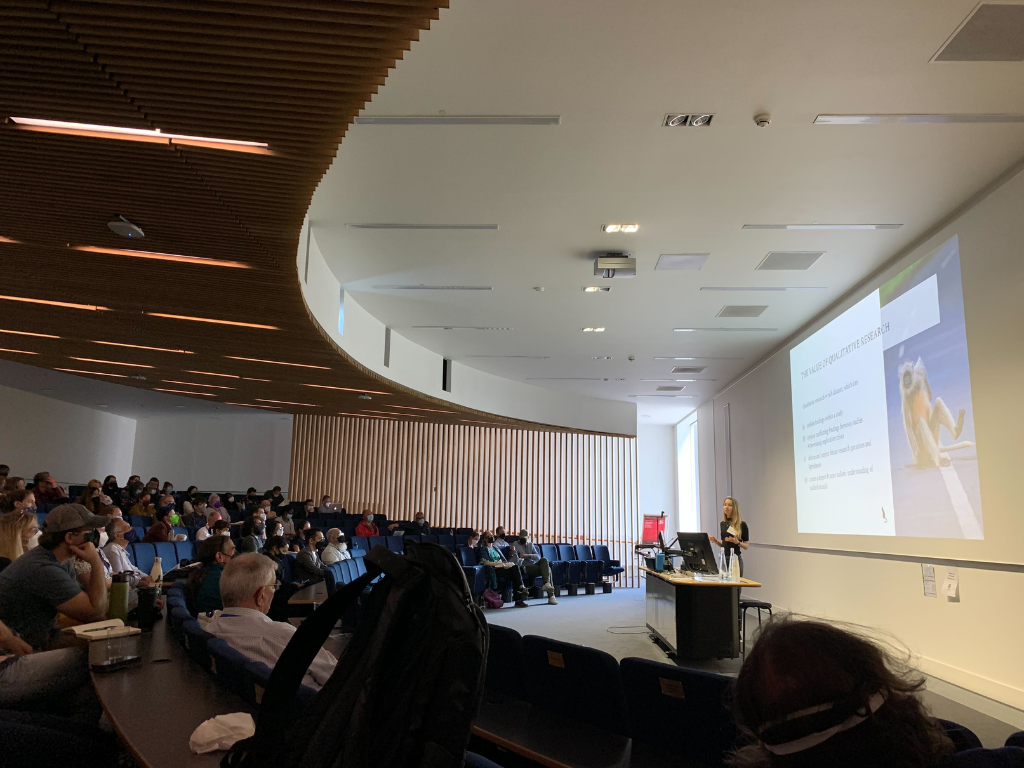
Brenda giving a talk on Animal Ethnography at the Diverse Intelligences Conference in St. Andrews, Scotland, 2022. Source: Dr. Erica Cartmill
Primatology starts with psychology: “Humans are animals too”
Brenda’s academic journey into primatology started with humans.
She studied psychology at the University of Amsterdam, partly because it was the closest she could get to studying animal behaviour at the time.
“I wanted to understand how animals experience the world,” she explains. “But there were no programmes like that in the Netherlands. Biology was too focused on plants, so I thought: ‘Humans are animals too.’”
During her BSc, she began searching for master’s programmes to feed her growing interest in evolutionary psychology and primate behaviour. When a local advisor told her to “ask Google,” she did exactly that.

Brenda is also a visual artist. Source: Brenda de Groot
That search led her to Oxford Brookes University in the UK, where she earned an MSc in Primate Conservation.
From there, her path took her across continents, from working as a researcher, campaigner, and writer in wildlife advocacy, to enrolling in a PhD programme in Anthropology at UCLA. But when her advisor relocated soon after she landed, so she decided to pivot once again.
She completed an MA in Anthropology, then made her boldest move yet: relocating to Japan to join Kyoto University’s world-renowned primatology programme.
Today, Brenda is right where she wants to be — immersed in primatology, surrounded by others just as obsessed with monkeys as she is.

Brenda and Professor Sugiyama, one of the early Japanese primatologists of Kyoto University. Source: Brenda de Groot
It may not seem philosophical, but the field of primatology is about asking deep questions, such as:
- What do primates think?
- What can their societies reveal about our own?
- How can we protect them in a rapidly changing world?
“Primates, just like us, experience emotions like love and trust,” Brenda says. “Those emotions are critical for their survival, just as they are for ours.”
By studying primates, scientists like Brenda are not only helping save endangered species but also uncovering insights into what it means to understand them and treat them with care and dignity.